2026-11-28
Wellshot: A Dubai-Built AI Film Studio in the Browser
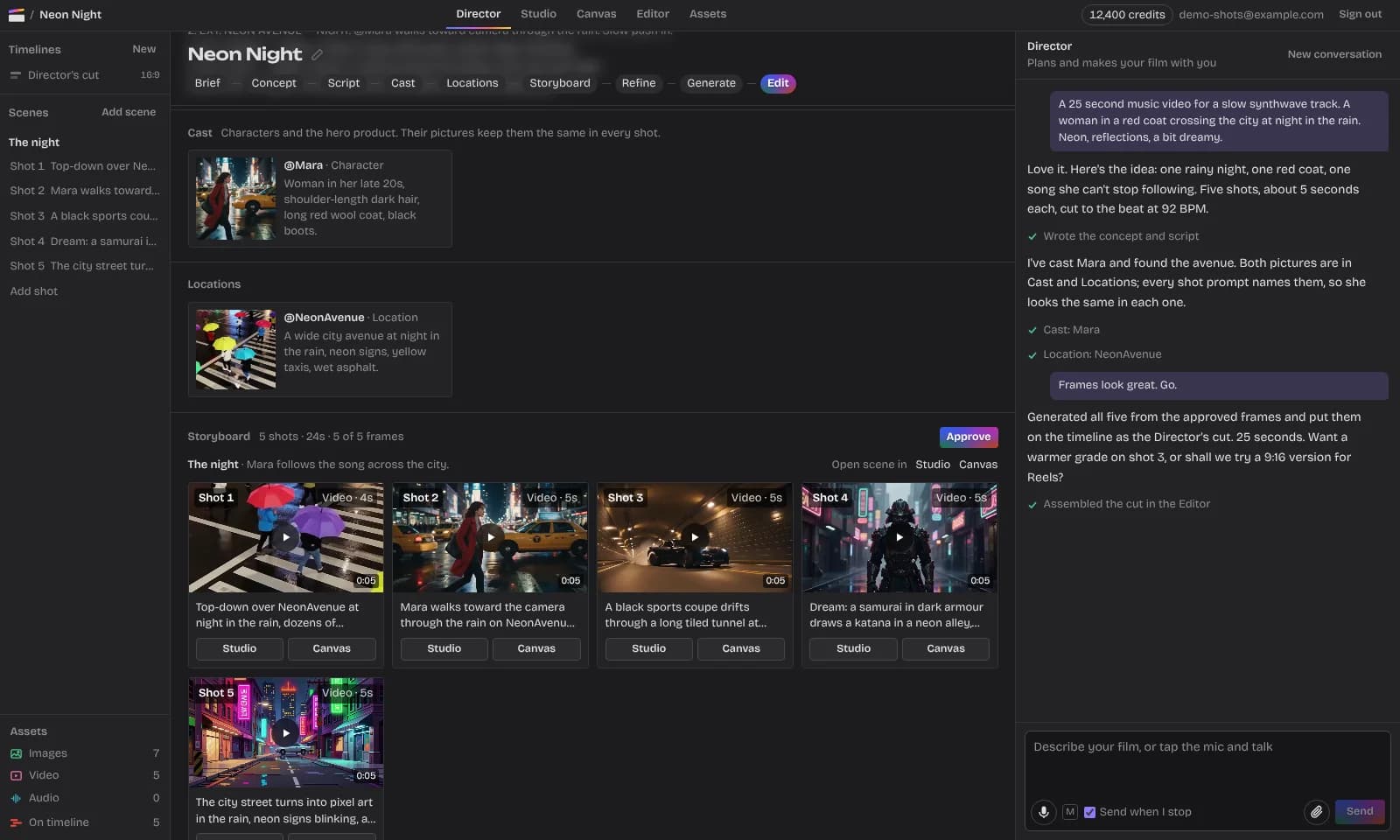
Most AI video work still runs across a pile of browser tabs. A team writes the script in a chatbot, generates stills in one tool, animates them in another, records a voice-over somewhere else, and then pulls everything into an editor. Every service has its own login, credit system and file format. Wellshot, a new platform built in Dubai, tries to put that whole chain into a single browser workspace. It calls itself “an AI film studio in the browser.”
This article looks at what Wellshot does, who is behind it, how it is priced, and where it fits in a crowded market of multi-model AI video platforms. Unless stated otherwise, the product details come from the company’s own website.
Who is behind it
Wellshot is made by JJ Agency Films, which describes itself as a Dubai-based production and post-production studio working across commercials, music videos, short fiction and AI-driven visual work. The agency lists more than ten years in production and more than 200 projects delivered. Its AI video service page names the tools it already uses for client work, including Sora 2, Runway, Google Veo 3, ByteDance Seedance, ElevenLabs, HeyGen, ComfyUI and Topaz Video AI.
That background shapes the pitch. According to the Wellshot about page, the product grew out of the studio’s own workflow, and it says Wellshot puts everything “in one place, around the way a production actually runs.” The site does not name individual founders, give a launch date, or mention investors.
What the platform does
Wellshot is organised around five work areas:
- Director: an AI agent that turns a plain-language brief into a script, scenes, a shot list and a storyboard. The company says it “picks the models and shows the price before it spends.”
- Studio: generation shot by shot, with reference images, a choice of model and per-shot settings.
- Canvas: a node graph that chains models together. Branches can be re-run on their own, so changing one shot does not mean regenerating everything.
- Editor: a timeline for trimming takes and exporting a cut.
- Sound: ElevenLabs voice-overs, dialogue, music, sound effects and dubbing into 16 languages.
Newer features include Stand-In, which the site describes as “keep the performance, swap the person,” a tool that splits a single image into separate transparent layers, and vector logo and title generation through Recraft. Wellshot also offers an MCP connector, so the platform can be driven from AI assistants and coding tools such as ChatGPT, Claude, Cursor and VS Code.

Sixty models behind one login
The main draw is model choice. Wellshot says it gives access to around 60 models: 29 for video, 15 for still images, 8 for layers and vector graphics, and 8 for voice and sound. The list includes ByteDance’s Seedance and Seedream families, Kuaishou’s Kling, Alibaba’s Wan, MiniMax, FLUX, Google’s Gemini image models, xAI’s Grok Imagine and PixVerse.
That matters because the models change quickly. In the first quarter of 2026 alone, VEED’s round-up counted launches including Lightricks’ LTX-2, Luma’s Ray3, Kling 3.0 (released 4 February with multi-shot generation in a single clip) and Seedance 2.0 (12 February). Each model has different strengths in motion, faces, text and consistency. A production that picks one model per shot needs either several subscriptions or a platform that sits on top of all of them.
Wellshot also highlights a draft-then-finish workflow. On Seedance 2.5, which the site says can produce up to 30 seconds in one take, users can test a shot at 480p before paying for a 1080p render.
Pricing
Everything runs on credits, and the pricing page says the cost is shown before each generation starts. At the time of writing, the published plans were:
| Plan | Who it is for | Listed price (USD, billed yearly) | Monthly credits |
|---|---|---|---|
| Creator | One person | $44 a month | 34,500 |
| Crew | 2 to 9 people, shared workspace | $59 per seat a month | 84,000 (shared) |
| Production | 5 to 50 people | $145 per seat a month | 570,000 (shared) |
| Enterprise | Large teams | Custom | Custom |
The Crew and Production plans require business verification. The site says credits are returned when a generation fails, top-up credits last 90 days, and a first payment can be refunded within 14 days only if no credits have been used. No free tier was listed. The page does not translate credits into a number of finished seconds, so the real cost per minute of footage depends on which models a team uses.
A crowded field
Wellshot is entering a busy market. A July 2026 comparison published by Higgsfield, one of the competitors, lists Dreamina (CapCut’s own platform for Seedance), fal.ai for developer API access, Runway, Magnific (formerly Freepik, which it says runs more than 40 models) and Higgsfield itself. Per-clip prices in that comparison ranged from about $2 to $7 for an eight-second 720p clip, though the figures come from a company that sells one of the options.
Against that field, Wellshot’s argument is less about the models, which competitors also offer, and more about structure. It pairs a planning agent, a node canvas and an editor in one place, and it was designed by a working commercial studio rather than a pure software company. Whether that holds up on real client jobs is something the market has yet to show. The site shows example clips labelled with the model that made them, but it does not yet name any productions or clients that have used the platform.
The UAE context
The timing fits the region. A 2025 Ipsos and ABG study cited by Communicate Online found that 96% of more than 100 marketing professionals surveyed in the UAE and Saudi Arabia had used AI tools, but only 26% used them regularly. The same study found that 70% worried about relying on AI without human oversight, and only 35% had received regular training.
Fully AI-generated commercials are already running in the market. In 2025, Emirates NBD released three AI-generated spots made by Studio Blo and scripted by Liwa.Content Driven, as reported by Indian Television. Studio Blo’s co-founder Dipankar Mukherjee told the publication: “If you don’t invest in the human craft, the machine will end up making something mediocre.”
That is the gap tools like Wellshot are trying to close. The bottleneck in AI production is rarely access to a model. It is keeping scripts, shots, versions, sound and spend organised across a team, which is the same job a production office does on a conventional shoot.
Questions worth asking before adopting it
- Rights and licensing: what rights does the team hold over generated output, and do they differ by underlying model?
- Likeness and consent: how does Stand-In handle consent from the performer and the person being swapped in?
- Real cost per minute: how many credits does a typical 30-second spot take once retakes and drafts are counted?
- Delivery specs: what resolution, frame rate, codec and colour space do exports support, and do they meet broadcast or cinema delivery?
- Data: where are uploaded references and client material stored and processed?
The bottom line
Wellshot is an early, studio-built attempt to turn a scattered set of AI tools into something closer to a production pipeline: plan, generate, cut and score in one place, with the price visible before each shot. Its model list and team plans are broad for a new entrant. What it still needs to show publicly is the work: named productions, delivery specifications and clear answers on rights. For producers in the UAE already experimenting with AI spots, it is worth testing on a real brief to see whether the single workspace saves as much time as it promises.
Cover image: Wellshot’s Director interface. Image: Wellshot. This article is based on public information from wellshot.ai, jjagency.co and the sources linked above; product claims are the company’s own.
Sources
- Wellshot homepage
- Wellshot: About
- Wellshot: Pricing
- JJ Agency Films: About
- JJ Agency Films: AI Video Production
- VEED: AI video model launches, Q1 2026
- Higgsfield: Best platforms to access Seedance 2.0
- Communicate Online: AI is rewriting advertising in the GCC
- Indian Television: Studio Blo crafts Emirates NBD ads